SecureCloud Hub. Real implementation details behind the Azure-native zero-trust file sharing platform.
This page documents the real implementation behind SecureCloud Hub: direct-to-Blob upload SAS, private storage containers, Event Grid-triggered malware scanning, user-scoped secure downloads, Terraform-managed Azure infrastructure, and observability through Application Insights, Function logs, and storage audit telemetry.
Browser → request_upload_function → incoming-raw
→ Event Grid → scan_function
→ safe-files / quarantine
→ download_function → read-only SAS → client download
Production-style Azure serverless workflow.
This architecture summarizes the real implementation behind SecureCloud Hub — from OIDC-based deployments and Terraform-managed infrastructure to authenticated uploads, Event Grid malware scanning, secure file isolation, and short-lived SAS-based downloads.
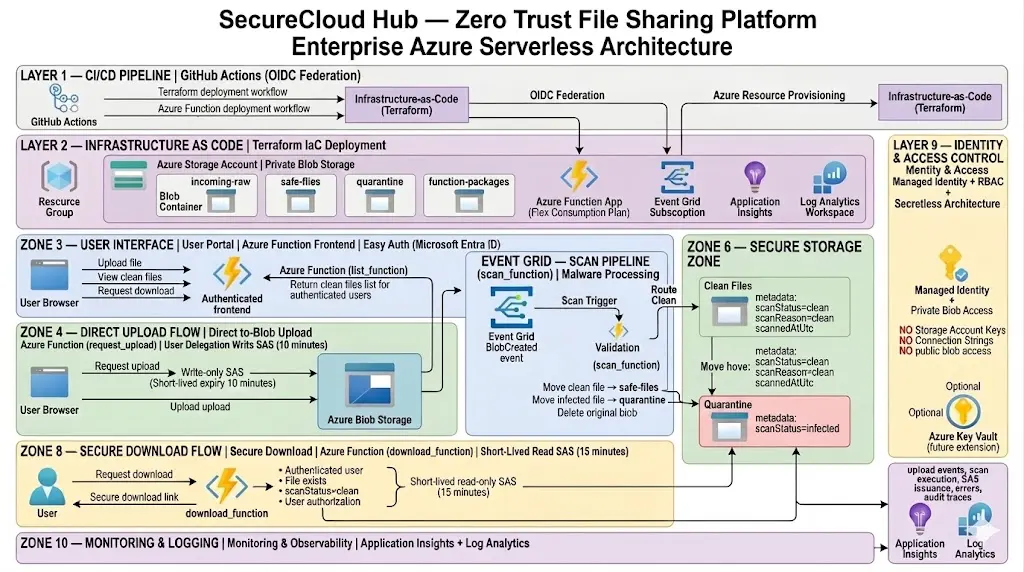
End-to-end secure file workflow
A high-level view of the platform flow across deployment, identity, storage, malware validation, secure downloads, and monitoring.
- GitHub Actions authenticates to Azure using OIDC for passwordless Terraform and Function deployments.
- Authenticated users upload directly to private Blob Storage using short-lived write SAS tokens.
- Event Grid triggers the malware scanning pipeline and routes files to clean or quarantine storage.
- download_function validates identity, file ownership, and clean scan metadata before issuing read-only SAS access.
Explore the implementation
Switch between Python Functions, Terraform IaC, CI/CD, observability, and the malware pipeline to see how each part of SecureCloud Hub works in the final implementation.
Python – download_function
The download function is the final access gate. It parses the authenticated Easy Auth principal, derives the
real user namespace, verifies the file exists inside safe-files, checks that the blob metadata
shows scanStatus=clean, and only then generates a 15-minute read-only user delegation SAS URL.
import base64
import datetime
import json
import logging
import os

import azure.functions as func
from azure.identity import DefaultAzureCredential
from azure.storage.blob import BlobSasPermissions, BlobServiceClient, generate_blob_sas

logger = logging.getLogger(__name__)


def parse_easy_auth_principal(req: func.HttpRequest) -> dict:
    principal_header = req.headers.get("X-MS-CLIENT-PRINCIPAL")
    if not principal_header:
        return {}

    try:
        decoded = base64.b64decode(principal_header).decode("utf-8")
        principal = json.loads(decoded)
        claims = {c["typ"]: c["val"] for c in principal.get("claims", [])}
        return {
            "user_id": claims.get(
                "http://schemas.xmlsoap.org/ws/2005/05/identity/claims/emailaddress",
                claims.get("preferred_username", "unknown"),
            ).lower(),
            "name": claims.get("name", "unknown"),
        }
    except Exception as exc:
        logger.warning("Failed to parse Easy Auth principal: %s", str(exc))
        return {}


def is_valid_filename(filename: str) -> bool:
    if not filename:
        return False
    if "/" in filename or "\\" in filename or ".." in filename:
        return False
    return True


def main(req: func.HttpRequest) -> func.HttpResponse:
    principal = parse_easy_auth_principal(req)
    user_id = principal.get("user_id", "unknown")

    if user_id == "unknown":
        logger.warning("Missing or invalid authenticated user.")
        return func.HttpResponse("Unauthorized.", status_code=401)

    file_name = req.params.get("fileName")
    if not file_name:
        logger.warning("Missing fileName. user=%s", user_id)
        return func.HttpResponse("fileName query parameter is required.", status_code=400)

    if not is_valid_filename(file_name):
        logger.warning("Rejected invalid fileName. user=%s file=%s", user_id, file_name)
        return func.HttpResponse("Invalid file name.", status_code=400)

    storage_url = os.environ["STORAGE_ACCOUNT_URL"]
    safe_container = os.environ["SAFE_CONTAINER"]

    blob_name = f"{user_id}/{file_name}"

    credential = DefaultAzureCredential()
    blob_service = BlobServiceClient(account_url=storage_url, credential=credential)
    blob_client = blob_service.get_blob_client(container=safe_container, blob=blob_name)

    try:
        properties = blob_client.get_blob_properties()
    except Exception:
        logger.warning("Blob not found. user=%s file=%s blob=%s", user_id, file_name, blob_name)
        return func.HttpResponse("File not found.", status_code=404)

    metadata = properties.metadata or {}
    scan_status = metadata.get("scanstatus", metadata.get("scanStatus", "unknown"))

    if scan_status != "clean":
        logger.warning(
            "Denied SAS issuance. user=%s file=%s blob=%s scan_status=%s",
            user_id,
            file_name,
            blob_name,
            scan_status,
        )
        return func.HttpResponse("File is not available for download.", status_code=403)

    now = datetime.datetime.now(datetime.timezone.utc)
    expiry = now + datetime.timedelta(minutes=15)

    delegation_key = blob_service.get_user_delegation_key(
        key_start_time=now,
        key_expiry_time=expiry,
    )

    account_name = storage_url.split("//", 1)[1].split(".", 1)[0]

    sas_token = generate_blob_sas(
        account_name=account_name,
        container_name=safe_container,
        blob_name=blob_name,
        user_delegation_key=delegation_key,
        permission=BlobSasPermissions(read=True),
        expiry=expiry,
    )

    sas_url = f"{storage_url}/{safe_container}/{blob_name}?{sas_token}"
Terraform – storage account, containers, lifecycle, and CORS
The storage layer is fully managed by Terraform. The account is private, versioned, lifecycle-managed, and includes CORS to allow the authenticated frontend hosted on the Function App to upload directly to Blob Storage using short-lived SAS URLs.
# ============================================================
# storage.tf
# Storage account + private containers + lifecycle rules
# ============================================================

resource "azurerm_storage_account" "main" {
  name                     = "st${var.project_name}${var.environment}001"
  resource_group_name      = azurerm_resource_group.main.name
  location                 = azurerm_resource_group.main.location
  account_tier             = "Standard"
  account_replication_type = "LRS"

  allow_nested_items_to_be_public = false
  min_tls_version                 = "TLS1_2"
  https_traffic_only_enabled      = true
  shared_access_key_enabled       = true

  blob_properties {
    versioning_enabled = true

    delete_retention_policy {
      days = 30
    }

    container_delete_retention_policy {
      days = 30
    }

    cors_rule {
      allowed_origins = [
        "https://${local.function_app_name}.azurewebsites.net"
      ]
      allowed_methods    = ["GET", "PUT", "OPTIONS"]
      allowed_headers    = ["*"]
      exposed_headers    = ["*"]
      max_age_in_seconds = 3600
    }
  }

  tags = local.common_tags
}

resource "azurerm_storage_container" "incoming_raw" {
  name                  = "incoming-raw"
  storage_account_id    = azurerm_storage_account.main.id
  container_access_type = "private"
}

resource "azurerm_storage_container" "safe_files" {
  name                  = "safe-files"
  storage_account_id    = azurerm_storage_account.main.id
  container_access_type = "private"
}

resource "azurerm_storage_container" "quarantine" {
  name                  = "quarantine"
  storage_account_id    = azurerm_storage_account.main.id
  container_access_type = "private"
}

resource "azurerm_storage_container" "function_packages" {
  name                  = "function-packages"
  storage_account_id    = azurerm_storage_account.main.id
  container_access_type = "private"
}
CI/CD – GitHub Actions with OIDC
The pipeline uses OpenID Connect to authenticate GitHub Actions to Azure without storing a long-lived client secret. One workflow applies Terraform and another publishes the Function App.
Infrastructure pipeline:
- Azure login via OIDC
- Terraform init / validate / plan / apply
- Remote state in Azure Blob Storage

Application pipeline:
- Azure login via OIDC
- Python setup
- Function App publish
- Runtime verification

Security outcome:
- No stored client secret in GitHub
- Azure trusts GitHub's OIDC token for the specific repo / branch
- Infrastructure and application deployments stay separated
KQL – scan lifecycle query
This query surfaces the full scan lifecycle from trigger to completion using the real trace messages emitted by
scan_function.
AppTraces
| where TimeGenerated > ago(24h)
| where Message has_any (
    "Scan triggered",
    "Scan completed",
    "Uploaded scanned blob successfully",
    "Deleted original blob from incoming container"
)
| project TimeGenerated, Message, SeverityLevel
| order by TimeGenerated desc
KQL – function runtime query
This query shows Function App runtime messages across the environment, useful for confirming executions, errors, and host-level activity.
FunctionAppLogs
| where TimeGenerated > ago(24h)
| project TimeGenerated, Level, HostInstanceId, Message
| order by TimeGenerated desc
KQL – storage audit query
This query captures the storage-layer side of the workflow: uploads, copies, and blob reads against the containers involved in the pipeline.
StorageBlobLogs
| where TimeGenerated > ago(24h)
| where OperationName in ("PutBlob", "PutBlockList", "CopyBlob", "GetBlob")
| project TimeGenerated, OperationName, ObjectKey, CallerIpAddress, AuthenticationType, StatusCode
| order by TimeGenerated desc
Malware pipeline – clean path
This is the real clean-file outcome tested in the project.
incoming-raw/kql-test-clean.txt
→ scanStatus = clean
→ uploaded to safe-files
→ original blob deleted from incoming-raw
Malware pipeline – infected path
This is the real infected-file outcome tested using the EICAR test string.
incoming-raw/kql-test-infected.txt
→ scanStatus = infected
→ uploaded to quarantine
→ original blob deleted from incoming-raw
Malware pipeline – execution sequence
This sequence matches the actual processing steps recorded by the scan pipeline from blob creation through final container placement.
Blob uploaded
→ Event Grid triggered
→ scan_function executed
→ blob downloaded
→ scan completed
→ destination container selected
→ scanned blob uploaded
→ original blob deleted